
Higher mortgage rates do not always mean a higher monthly payment when you’re comparing homes at different prices. A lower purchase price can reduce the amount you borrow enough to offset a higher rate.
If you’ve been waiting to buy a home in Utah because rates feel high, it may be time to revisit the full picture.
Your interest rate matters. However, so do the purchase price, down payment, and loan amount.
How can a higher rate produce a lower payment?
Your monthly principal-and-interest payment depends on three things: the amount you borrow, your interest rate, and your loan term. Therefore, comparing rates alone leaves out part of the equation.
Consider the May-to-October comparison below. Both options use a 30-year fixed-rate mortgage with 20% down.
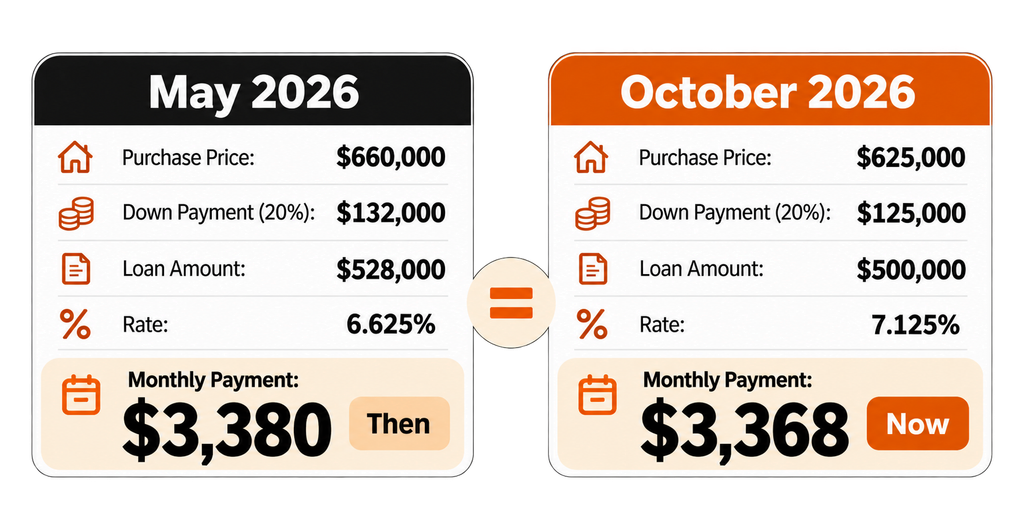
In the May example, a $660,000 purchase price requires a $132,000 down payment. That leaves a $528,000 loan. At 6.625%, the monthly principal-and-interest payment is approximately $3,380.
In the October example, the purchase price is $625,000, with a $125,000 down payment. The loan amount drops to $500,000. Even at the higher rate of 7.125%, the payment is approximately $3,368.
The rate went up. The payment stayed nearly identical. Meanwhile, the down payment dropped by $7,000.
These two purchase scenarios show how the math works; they do not represent a statewide change in Utah home values.
What should Utah homebuyers take away from this?
The point is bigger than a small monthly difference.
Looking only at higher mortgage rates could cause you to overlook a home that fits your budget.
For example, a property with a reduced asking price may deserve another look—even if rates have increased since you first considered buying.
That does not mean every home is a better deal today. Instead, it means you need updated numbers for the properties you’re considering.
Should you buy now or keep waiting?
Start with your budget and your reason for moving.
Maybe your family needs more space. Perhaps you’re ready to downsize, move closer to family, or stop maintaining rooms nobody uses.
Those needs do not disappear while you wait for a particular interest rate.
Before putting your plans on hold, compare:
- The home’s current purchase price.
- Your available down payment.
- Closing costs and any negotiated seller contributions.
- Your complete monthly housing payment.
- The savings you’ll have left after closing.
Also, remember that principal and interest are only part of your housing expense. Include property taxes, homeowners insurance, and any applicable mortgage insurance or HOA dues when evaluating affordability.
Look beyond higher mortgage rates
Calling it a “bad market” does not tell you whether it’s a bad time for you to move.
Waiting may make sense. Moving may make sense. Either way, you deserve to make that decision using numbers that reflect your situation.
Our Houzd Mortgage team can review purchase prices, down payment options, and your full monthly payment so you can see what’s realistic.
You may still decide to wait. But let’s make sure you’re waiting because it fits your goals—not because a rate headline made buying seem out of reach.